
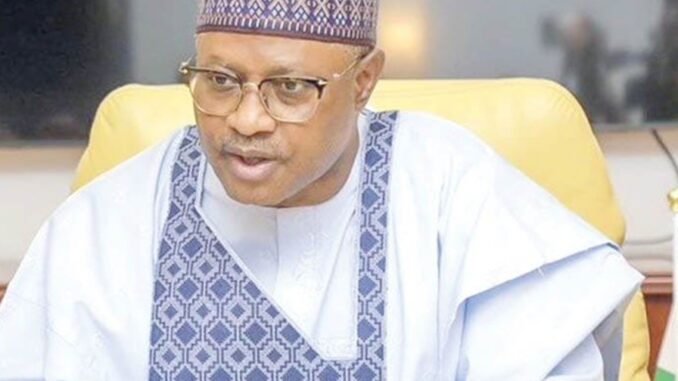
By Baba Jibril
Before he became senator, before he became governor, Uba Sani was a pro-democracy activist and human rights defender. This chapter of his life is often overlooked. It should not be. It is the crucible in which his character was forged.
When the military annulled the June 12, 1993, presidential election—widely believed to have been won by Chief MKO Abiola—Uba Sani was a young professional in his early twenties. While many of his contemporaries chose silence and safety, Sani chose resistance. He joined the pro-democracy movement, aligning himself with groups like the National Democratic Coalition (NADECO) and the Campaign for Democracy (CD). These were underground movements that organised protests, published critical newsletters, and risked arrest, torture, and even death at the hands of the military junta of General Sani Abacha.
Sani’s role was unsung but significant. He helped coordinate student protests at Kaduna Polytechnic. He produced and distributed pamphlets exposing the military’s human rights abuses. He organised secret meetings in private homes. When Abacha’s regime unleashed its notorious security apparatus on dissidents, many of Sani’s colleagues were arrested, detained without trial, and some simply disappeared. Sani himself was repeatedly harassed and briefly detained on at least three occasions. He was questioned by the State Security Service about his “subversive activities.” Each time, he was released for lack of evidence, but the message was clear: he was being watched.
Years later, speaking about this period, Sani said: “There was no guarantee that I would survive. My mother wept every time she heard of another arrest. But I could not stand by while the military stole our democracy. I believed then, and I believe now, that the people have the right to choose who governs them. That is a right worth dying for.”
After the return of democracy in 1999, Sani did not abandon his activist roots. He redirected them from street protest to institutional advocacy. In the Senate, he opposed legislation that threatened press freedom and supported motions calling for investigations into military excesses.
When Nasir Ahmad El-Rufai became governor of Kaduna State in 2015, he found in Uba Sani a loyal ally. Sani had worked with El-Rufai in the FCT Administration. El-Rufai recognised Sani’s intelligence, work ethic, and loyalty. He appointed Sani as Special Adviser on Political and Intergovernmental Affairs. For years, the relationship appeared close. El-Rufai mentored Sani, teaching him the intricacies of statecraft. When Sani contested for the Senate in 2019, El-Rufai campaigned for him.
But the truth, as it would later emerge, was more complicated. Contrary to the public narrative of a political father-son relationship, El-Rufai never actually wanted Uba Sani to become governor. From the very beginning, El-Rufai had a different candidate in mind—someone he believed he could control, someone who would not question his legacy or his methods. When Sani indicated his ambition to succeed El-Rufai in 2023, the outgoing governor did not embrace him as an anointed son. Instead, he created a deliberately difficult environment for Sani, erecting multiple screening committees designed to frustrate his candidacy among the many contenders for the governorship.
These committees were not mere formalities. They were obstacles, carefully calibrated to trip Sani up, to find any excuse to disqualify him, or to simply wear him down until he withdrew from the race. Each committee demanded new documentation, new clarifications, new appearances. The process dragged on for months. Sani was made to appear before one panel after another, answering the same questions, facing the same hostile interrogators, knowing that the man who was supposed to be his political father was pulling the strings behind the scenes, hoping he would fail.
Yet Sani scaled through every single hurdle. He answered every query. He provided every document. He appeared before every committee. He did not withdraw, he did not complain publicly, and he did not attack his mentor. He simply kept his head down and kept moving forward, trusting that if God wanted him to become governor, no human committee could stop him.
When the dust settled and Sani emerged as the candidate, there was no celebration from El-Rufai. There was no public endorsement, no ringing declaration of support. Sani was never truly El-Rufai’s anointed candidate. He had forced his way through the gauntlet that was meant to eliminate him, and he had won. But the experience left him wondering. He had spent years serving this man loyally, and yet the man had tried to block his path at every turn. What had he done to deserve such treatment? What had he missed? The questions haunted him, but he did not dwell on them. He had a campaign to run, and then a state to govern.
In the end, it was not El-Rufai’s endorsement that delivered the governorship to Uba Sani. It was the people of Kaduna State, who saw in him a man of integrity, a man who had survived the political wilderness without compromising his values. And as Sani himself would later reflect, it was God in His infinite mercy who chose him, over and above the machinations of men who sought to deny him his destiny.
Sani was sworn in on 29 May 2023. It was supposed to be the culmination of his political journey, a moment of triumph. Instead, it became the beginning of his greatest trial. His transition team received handover notes that were devastating. There were undisclosed liabilities running into hundreds of billions of naira, unpaid pensions, unpaid gratuities, unpaid contractor debts dating back years. There were financial irregularities that would later be quantified at over ₦450 billion, with inflated contracts, abandoned projects, and diverted funds. The state’s liquidity account had less than ₦2 billion—barely enough for one week of the ₦8 billion monthly payroll. Over ₦6 billion was being deducted monthly at source to service inherited loans, leaving less than ten percent of monthly allocations for all capital projects.
There were more than eight thousand ghost workers on the payroll, siphoning approximately ₦600 million every month. The security situation was dire, with over one thousand two hundred people kidnapped and eight hundred killed in bandit attacks in 2022 alone. The education system had collapsed, with over sixty percent of public school teachers untrained and more than five hundred fifty thousand children out of school. The health system was in ruins, with half of primary healthcare centres lacking running water and one-third without electricity. One transition team member later recalled: “We walked into the meeting expecting a leaking roof. We found a condemned house. Some of us were close to tears.”
Sani faced a choice: cover up the mess to protect his mentor, or expose it to save the state. He chose the state. In late 2023, Governor Sani issued an executive order directing all government agencies to conduct a comprehensive audit of the state’s finances. In January 2024, during a state broadcast, Sani made his position clear without being confrontational: *”The people of Kaduna State deserve to know the truth. We inherited a government that left us with crippling debt and a bloated, corrupt payroll. We have a choice: we can hide this truth and continue the cycle of impunity, or we can expose it and begin the process of healing. I choose the truth.”*
Those who know Sani say he was devastated by the necessity of this decision. He had genuinely trusted El-Rufai, even after the screening committee ordeal, believing that perhaps the man had simply been cautious, not malicious. But now the evidence was undeniable. El-Rufai had left the state in ruins, and Sani could not pretend otherwise. His oath of office was to the people of Kaduna State, not to any individual.
El-Rufai’s response was brutal. In interviews and leaked WhatsApp messages, he accused Sani of “betrayal” and “ingratitude.” He claimed Sani was “not his own man” and was being controlled by forces hostile to him. He dismissed Sani’s achievements as “falsehood” and suggested that the governor was “hiding behind debt” to excuse incompetence. More damagingly, El-Rufai allegedly attempted to undermine Sani from within—leaking confidential information to political opponents, encouraging disgruntled civil servants to resist the new administration, and using his connections in Abuja to delegitimise Sani’s appointment of his own cabinet.
By late 2024, the Kaduna State House of Assembly had constituted an ad hoc committee to investigate the financial transactions of the El-Rufai administration. The committee’s report, presented in October 2024, was damning. It alleged over ₦450 billion in financial irregularities, including inflated contracts, unauthorised deductions, and unexplained transfers. It documented ₦150 billion in untendered loans, allegedly borrowed without legislative approval. It confirmed the existence of eight thousand ghost workers siphoning approximately ₦600 million monthly. It found evidence of funds diverted from education, health, and infrastructure projects, as well as the sale of government assets at undervalued prices to preferred buyers. The committee recommended further investigation by the Economic and Financial Crimes Commission, the Independent Corrupt Practices Commission, and the Nigeria Police Force.
As of early 2025, the EFCC has reportedly opened an investigation into the ₦450 billion irregularity allegations. Several contractors have come forward claiming they were paid grossly inflated sums for substandard work during El-Rufai’s tenure. The Code of Conduct Bureau is reportedly examining El-Rufai’s asset declarations before and after his governorship. El-Rufai has denied all allegations, dismissing them as politically motivated persecution. He has accused Sani of orchestrating the investigation as revenge for their falling out. However, no credible evidence has linked Sani to the investigations; they appear to have been initiated independently by the anti-corruption agencies after the House of Assembly’s public report.
Where was Governor Sani during these proceedings? He did not personally lead the charge against El-Rufai—that would have been seen as vendetta. Instead, he allowed the House of Assembly to conduct its investigation independently, and he publicly affirmed his commitment to the rule of law: “I did not become governor to settle scores. I became governor to serve the people. If the legislative branch finds evidence of wrongdoing, the executive will respect the law. I will not obstruct justice for any man, regardless of my personal history with him.”
One of the fiercest criticisms levelled against Uba Sani by El-Rufai’s supporters and opposition figures is that he is rarely physically present in Kaduna State. The accusation goes that Governor Sani is always travelling, that he does not live in Kaduna, that he lives in Abuja, and that he only visits Kaduna for ceremonies and photo opportunities. This attack has been amplified on social media, with critics sharing snippets of his travel schedule and claiming he spends more weekends in the capital than in his own state.
The facts tell a different story. Kaduna State is heavily dependent on federal allocations. The governor must attend National Economic Council meetings, lobby federal ministries for project funding, coordinate with security agencies in Abuja, and meet with international development partners and investors. These are not absences—they are essential functions of the office. Despite the claim of absence, Governor Sani has been physically present in Kaduna State for the vast majority of his tenure. In his first twelve months alone, he conducted over one hundred public engagements within Kaduna State, including commissioning thirty road projects and visiting fifteen local government areas for community outreach. He has personally presided over security council meetings in Kaduna, often travelling to the most dangerous parts of the state, including Birnin Gwari and Chikun. He maintains and uses the Governor’s Lodge in Kaduna.
Why do El-Rufai’s allies push this narrative? Because they know it is one of the few criticisms that can resonate with ordinary citizens who may not read audit reports or budget documents. It is a cheap shot designed to undermine Sani’s credibility while avoiding substantive discussion of his achievements. When asked about the criticism, Governor Sani responded with uncharacteristic sharpness: “I refuse to be blackmailed by those who are unhappy that I am doing my job properly. My job is to be where the needs of Kaduna State take me. If I am in Abuja fighting for a federal allocation for Kaduna, I am working for Kaduna. If I am in China seeking investors for Kaduna, I am working for Kaduna. If I am in Birnin Gwari at midnight reassuring farmers, I am working for Kaduna. They can say whatever they want. The evidence of my work is in every classroom, every health centre, every road, and every bank account that now has money in it.”* It is worth noting that the same critics who accuse Sani of travelling were silent when El-Rufai reportedly clocked up tens of thousands of miles in foreign trips, including extended medical sojourns, that consumed significant state funds.
Despite the attacks, the evidence of Sani’s governance is measurable and verifiable. Despite inheriting crippling debts, Governor Sani has paid over ₦90 billion of inherited debt without taking any new loans. He has maintained consistent, on-time salary payments for all civil servants for over thirty consecutive months—a feat that did not happen for years before him. Kaduna is implementing eight World Bank-supported projects, including AGILE, KADRAAMP, and ACReSAL. The state has committed over ₦11.5 billion in counterpart funding. The World Bank itself has praised Kaduna as a benchmark for effective implementation of donor-funded initiatives.
In healthcare, two hundred fifty-five Primary Healthcare Centres have been upgraded to Level-2 facilities, with twenty-three centres of excellence established. A three hundred-bed Specialist Hospital has been delivered, and one thousand eight hundred healthcare workers recruited. The KADSEMSAS emergency ambulance system is operational, with two point one million children protected against malaria and four point three million insecticide-treated mosquito nets distributed. In education, seven hundred thirty-six classrooms have been constructed and over one thousand two hundred renovated. Ten thousand teachers have been recruited through transparent competitive exams. Out-of-school children have been reduced from five hundred fifty thousand to one hundred eighty-seven thousand seven hundred twenty. Tuition fees in state tertiary institutions have been reduced by forty percent, and the 2024 WAEC credit pass rate in mathematics and English jumped from thirty-six percent to seventy-seven percent.
In infrastructure, one hundred fifty road projects covering over one thousand three hundred kilometres have been initiated across all twenty-three local government areas. The Goningora–Kuyello road in Chikun Local Government Area transformed a farming community of five thousand people, with transport costs falling by fifty percent. In agriculture, the budget increased from ₦1.48 billion in 2023 to over ₦74 billion in 2025, with a consistent ten percent budgetary allocation over three consecutive budgets. Over one hundred thousand smallholder farmers have been enrolled in crop insurance, and farmer income has risen by forty-five percent. In peace and security, Kaduna has recorded zero violent conflict since 2023. Major bandit attacks fell from forty-one in the first half of 2023 to just five in the first half of 2024. The Community Intelligence and Response Framework has established village-level security committees and trained five thousand volunteers.
In investment and economic growth, twenty-three investments have been actualised at over seven hundred forty-three million dollars, with two point five billion dollars in total investment commitments. Business registration has been reduced to two days online for one thousand naira, down from twenty-five thousand naira and three months. In social protection, two point five million new bank accounts have been opened, and over eighteen billion naira in targeted support has been deployed to households, farmers, and small businesses. Widow’s gratuities have been paid, and teacher salaries are paid on time.
Uba Sani’s journey from pro-democracy activist to governor has been punctuated by moments where he had to choose between personal loyalty and public duty. Each time, he chose the latter, even when it cost him friendships, allies, and comfort. When he stood up to El-Rufai’s financial mismanagement, he knew he would face the wrath of a powerful political godfather. He knew El-Rufai had connections at the highest levels of the federal government. He knew his political career could be destroyed. He did it anyway.
When he took the witness stand at a national assembly committee hearing on the state’s debt crisis, he testified without rancour but without flinching: “I have a duty to tell the truth. The truth is that Kaduna State was left in a financial grave. I am still digging us out. I have never once thought of blaming others for the challenges we face. But I will not lie to the people whose salaries I am now paying from the little we have.”
When asked whether the rift with El-Rufai could ever heal, Sani responded: *”I have no enemies. I have only faced a crisis, and I have chosen to solve it. If Mallam El-Rufai believes I have wronged him by telling the truth, I cannot change his heart. But I can change Kaduna. I have changed Kaduna. And for that, I owe no apology to any man—only to the people who elected me.”
As Kaduna State approaches the 2027 gubernatorial election, the people face a choice that will define the state’s trajectory for decades. They could elect someone who promises dramatic change but has no track record of financial discipline. They could choose a candidate who will say whatever it takes to win. They could return to the era of unpaid salaries, abandoned projects, and hidden debts. Or they could re-elect a man who has shown that governance can be honest, that debt can be repaid, that salaries can be paid on time, that peace can be achieved, and that progress is possible even under the most constrained circumstances.
The 2027 election will not be about slogans. It will be about questions. Did you have a government that paid you on time? Yes, under Uba Sani. Did you have a government that built classrooms and improved exam results? Yes, under Uba Sani. Did you have a government that upgraded your health centre and brought an ambulance? Yes, under Uba Sani. Did you live without war, without daily kidnappings, without fear? Yes, under Uba Sani. Did your farmer neighbour earn more from his crops? Yes, under Uba Sani.
The critics will scream. The hashtags will fly. The misinformation will spread. But the people of Kaduna know what they have lived through. They know who has served them. That is the legacy he is building. He is not producing grand spectacles or vaunted mega-projects. He is building one classroom, one health centre, one road, one pension payment, one month of salary at a time.
In 2027, the people of Kaduna will decide whether the lantern of integrity continues to burn, or whether they will allow the darkness to return. The evidence is clear. The choice is theirs.
In summary: Governor Uba Sani survived the brutal betrayal of his political mentor, Nasir El-Rufai, who never truly wanted him as governor and created multiple screening committees to block his path. Despite this, Sani scaled through by sheer perseverance and the grace of God. He inherited a state drowning in debt and corruption, exposed the rot, and has since paid ₦90 billion of inherited debt, eliminated ghost workers, reduced out-of-school children by two-thirds, transformed healthcare, achieved zero violent conflict, and earned the World Bank’s public praise. The accusation that he does not stay in the state collapses under the weight of over one hundred documented public engagements in Kaduna in his first year alone. The question for 2027 is whether the people will reward integrity or return to the familiar shadows.
Baba Jibril is a Public Commentator and Policy Analyst write from Kaduna
Leave a Reply