
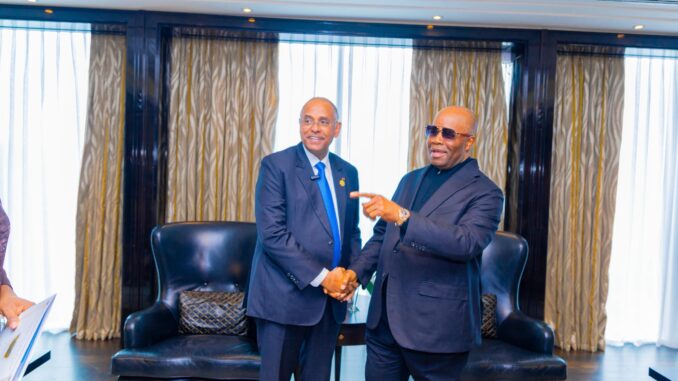
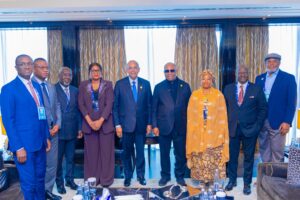
 The President of the Senate of the Federal Republic of Nigeria, Godswill Akpabio, has reaffirmed Nigeria’s commitment to strengthening bilateral and regional cooperation with the Republic of Côte d’Ivoire, following a high-level meeting with the Speaker of the Ivorian National Assembly, Patrick Jérôme Achi, on the sidelines of the 152nd Assembly of the Inter-Parliamentary Union (IPU) in Istanbul, Turkey.
Welcoming the Ivorian delegation, Senator Akpabio described Côte d’Ivoire as a “historic partner and brother nation,” emphasizing that the enduring relationship between both countries remains central to the future of West Africa.
“If we unite as a bloc, we will be stronger in trade, economic cooperation, political collaboration, and cultural exchange. Otherwise, we risk a return to new forms of neocolonialism,” he warned.
Both leaders underscored the urgent need for deeper regional integration, calling for a strengthening of the Economic Community of West African States (ECOWAS) and the reintegration of countries in the Sahel region.
The Senate President stressed that in a rapidly fragmenting global order, West Africa must act collectively to safeguard its economic and political future.
A major highlight of the discussions was the Abidjan–Accra–Lagos Coastal Highway, a flagship regional infrastructure project designed to connect over 300 million people across West Africa.
The project, once completed, is expected to: reduce travel time between Lagos and Abidjan from three days to about eight hours, operate as a modern, double-carriage superhighway, be governed under a supranational legal and operational framework, and eliminate excessive border delays through harmonized regional laws
Five ECOWAS countries have already enacted legislation to ensure seamless cross-border movement, modeled after open-border systems.
“This project is not just a road; it is an economic artery that will redefine mobility, trade, and integration across West Africa,” Akpabio noted while commending President Ahmed Bola Tinubu for his commitment to the project.
In his response, Speaker Achi emphasized that Africa’s development must be driven by private sector-led growth, supported by strong governance and legislative oversight.
“Governments do not grow economies — the private sector does,” he stated, calling for policies that unlock investment, expand markets, and create jobs for Africa’s rapidly growing youth population.
He identified peace, stability, education, and economic opportunity as the pillars for sustainable development, warning that without these, the region risks falling behind despite its vast resources.
Both leaders acknowledged persistent challenges, including, language barriers, fragmented markets, weak infrastructure, and brain drain.
They agreed that Africa must harness its human capital and natural resources more effectively, noting that the continent is “walking on wealth it does not fully recognize.”
Concerns around security and open-border systems were discussed, with emphasis on: technology-driven surveillance systems, smart border management, and regional intelligence cooperation.
The leaders also warned of emerging risks, including the potential for digital and economic recolonization and urged for proactive investment in technology and innovation.
Both parties committed to deepening parliamentary collaboration, enhancing oversight of regional projects, and coordinating legislative frameworks to support integration.
In closing, both leaders described Nigeria and Côte d’Ivoire as “strategic pillars of West Africa,” capable of driving the region’s transformation if they act in concert. “If we work together, nothing is impossible,” Achi affirmed.
Leave a Reply